FullStory alternatives - Top 10 analytics tools to choose


If you're exploring AI-powered product analytics platforms before committing to FullStory, you're in the right place. The best analytics tools today go beyond dashboards and session replays, they use AI to explain why users behave the way they do and recommend what to fix next.
FullStory is a robust web and mobile analytics tool, but some platforms may specialize more deeply in specific features you need, or offer a better fit for your budget.
In this article, we’ll review 10 of the best FullStory alternatives, highlight what each platform does best, and compare them to help you narrow down your options.
What are the best FullStory alternatives?
The top software and best alternatives to FullStory are: UXCam, Amplitude, Heap, Mixpanel, and Hotjar.
UXCam - Best AI-powered product analytics platform for mobile and web, with a built-in AI product analyst.
Amplitude - Best for future outcomes predictions.
Heap - Best for automatic event capture and robust funnel analytics.
Mixpanel - Best for advanced event tracking, user cohorts, and predictive insights.
Hotjar - Best for visual behavior analytics with integrated user feedback.
What is FullStory used for?
FullStory dubs itself a “Digital Experience Intelligence (DXI) platform” using web and mobile analytics to understand user behavior. It combines quantitative and qualitative data to help businesses understand the complete picture of their user experience.
FullStory excels in real-time behavioral insights, allowing teams to instantly identify pain points and optimize the user journey. With feature like session replay, FullStory helps product teams see what users are doing.
For example, businesses can quickly pinpoint user struggles during key actions (whether it's a purchase, form submission, or app navigation) and immediately adjust the design or experience to enhance user satisfaction and drive better outcomes.
FullStory excels for product teams, UX/UI designers, and customer experience (CX) teams who need real-time behavioral data across web and mobile. FullStory’s session replay make it ideal for teams focused on quick iteration and optimization.
Key features of FullStory


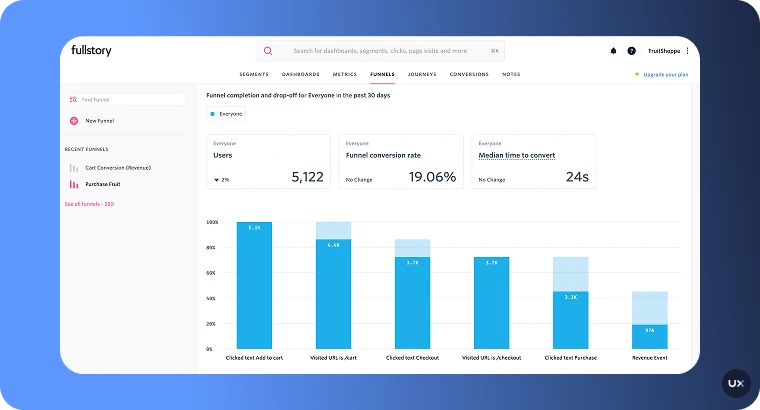
FullStory comprises three main offerings:
Complete data campture As the name implies, FullStory auto logs all aspects of users’ interactions on your site or app, such as scroll, swipe, click, and pageview, without manual tagging. This provides a granular view of the entire user journey, helping teams identify friction points and optimize the experience quickly.
Product analytics Their tightly packed visual dashboards organize the data in a way that makes it easy to map out sales funnels, track common paths, uncover behavior patterns, and identify friction points.
Teams focused on conversion optimization and behavioral segmentation (like growth and product teams) benefit greatly here. FullStory’s funnels and dashboards are ideal for teams measuring user acquisition, engagement, and retention.
Session insights Advanced record and playback tools enable customer experience (CX) teams to capture user sessions across browsers, interfaces, and devices. This capability is particularly valuable in diagnosing issues and improving customer experience (CX). FullStory’s AI-powered insights automatically surface important user behavior trends, reducing the time needed for teams to dig into complex datasets and resolve issues faster.
This feature is perfect for customer support teams and CX teams who need to diagnose user issues and optimize support processes based on real user interactions.
You might also be interested in Firebase alternatives and competitors.
FullStory pricing
FullStory offers three plan types: Business, Advanced, and Enterprise under its Analytics tier. Each plan includes different features and capabilities tailored to the needs of the organization, and you can get started with a 14 day-trial. You'd have to reach out to the sales team to get a quote for the actual cost. Here is a summary of each plan based on the details found on their plans page:
Business plan: This plan is suitable for organizations that need to capture and analyze user interactions to gain insights and improve their digital experience.
Advanced plan: The Advanced plan is designed for companies that require deep product analytics and qualitative insights to grow with agility.
Enterprise plan: The Enterprise plan provides total, cross-functional clarity into the organization's digital portfolio
FullStory also provides two more tiers: Workforce (aimed at internal tool and employee experience teams) and Anywhere (designed for data teams and advanced analytics use cases).
Why is it worth considering FullStory alternatives?
FullStory is used by enterprises and large organizations, but the platform has a few shortcomings.
Mobile integrations: While FullStory works for mobile apps, the web/mobile hybrid platform doesn't cover every framework, particularly with non-native tech stacks (e.g., Flutter, React Native). So if you’re a mobile app team, consider using a mobile-first analytics platform.
Hybrid platform limitations: Like most hybrid platforms, FullStory was a web analytics platform that expanded its capabilities to mobile. Which means if you are a mobile-invested company, they may not have as advanced mobile app capabilities as a made-for-mobile analytics platform. Native app teams, in particular, may benefit more from tools built specifically for mobile behavior analysis.
Pricing for mobile: FullStory charges by session, not unique users. So if users go and come back, it counts as another session, which can make scaling, especially on mobile, very expensive. For highly scaled mobile apps, this pricing model may make it more expensive compared to alternatives that charge per user or offer more predictable pricing.
Opaque pricing and enterprise focus: Users also say their website pricing is a bit opaque. FullStory.com seems to be more geared towards enterprise and larger organizations. The opaque pricing also means that users often need to engage with sales teams to get a customized quote, which may not suit businesses looking for straightforward, transparent costs.
Learning curve: Creating custom events and interpreting complex datasets requires technical expertise, and new users who aren’t data-savvy will need a bit of time trying to understand the platform. This learning curve can slow adoption and make FullStory less accessible for teams that need faster, more intuitive tools for their day-to-day analytics.
Comparing the best alternatives to FullStory
To help you choose the best option for your mobile app and product, let's dive into how each FullStory competitor stacks up.
| Tool | G2 Rating | Primary Focus | Pricing Model | Strengths | Weaknesses |
|---|---|---|---|---|---|
| FullStory | 4.6/5 | Digital Experience Intelligence (DXI) Platform | Custom pricing via sales team | Real-time session replay, AI-powered insights, cross-platform | Expensive for smaller teams, steep learning curve |
| UXCam | 4.6/5 | Web + Mobile Product Analytics + Experience Analytics | Free up to 3,000 monthly sessions | AI-powered product analytics with a built-in AI analyst (Tara), session replay, heatmaps, funnels, and issue analytics for web and mobile; autocapture and strong integrations. | Some advanced analytics workflows may require setup/planning (events, taxonomy) |
| Amplitude | 4.5/5 | Product Analytics | Free plan, paid plans from $49/month | Advanced AI predictions, segmentation, cohort analysis | Session replay is not the core product experience |
| Chartbeat | 4.4/5 | Content Analytics | Custom pricing via sales team | Best for content-focused sites, real-time performance insights | Not ideal for product UX/session replay comparisons |
| Mouseflow | 4.6/5 | Website Conversion Optimization | Free for 500 recordings, starts at $39 | Affordable, heatmaps, session replays, easy setup | No mobile app support, limited features compared to FullStory |
| Datadog | 4.3/5 | Cloud & Product Monitoring | Feature-based pricing from $15/month | Granular performance monitoring, integration with DevOps tools | Not a DX/session replay product analytics platform |
| Plerdy | 4.7/5 | Conversion Rate Optimization + UX + SEO | Free, with add-ons starting from $5 | Integrates UX, CRO, SEO in one platform, affordable, user-friendly | More focused on websites, lacks advanced session replay |
| Heap | 4.4/5 | Automatic Event Capture + Funnel Analytics | Free for 10,000 sessions/month, custom paid tiers | Automatic event tracking, minimal setup, retroactive insights | Limited session replay, less emphasis on qualitative data |
| Glassbox | 4.9/5 | Enterprise-level Digital Experience Analytics | Custom pricing | Automatic session capture, AI-assisted struggle scoring, enterprise-grade | Expensive, more complex setup compared to FullStory |
| Mixpanel | 4.5/5 | Behavioral Product Analytics + Predictive Insights | Free (Basic), Growth an Enterprise (custom) | Event-based tracking, predictive insights, unlimited users for collaboration | Not as strong in session replay, complex for beginners |
| Hotjar | 4.6/5 | Website Behavior + User Feedback | Free plan, paid plans from $49/month | Easy to use, fast insights, user feedback, heatmaps, session replays | Limited mobile app support, less deep analytics than FullStory |
UXCam vs FullStory
G2 rating: 4.6/5
Cost: Free for up to 3,000 monthly sessions.


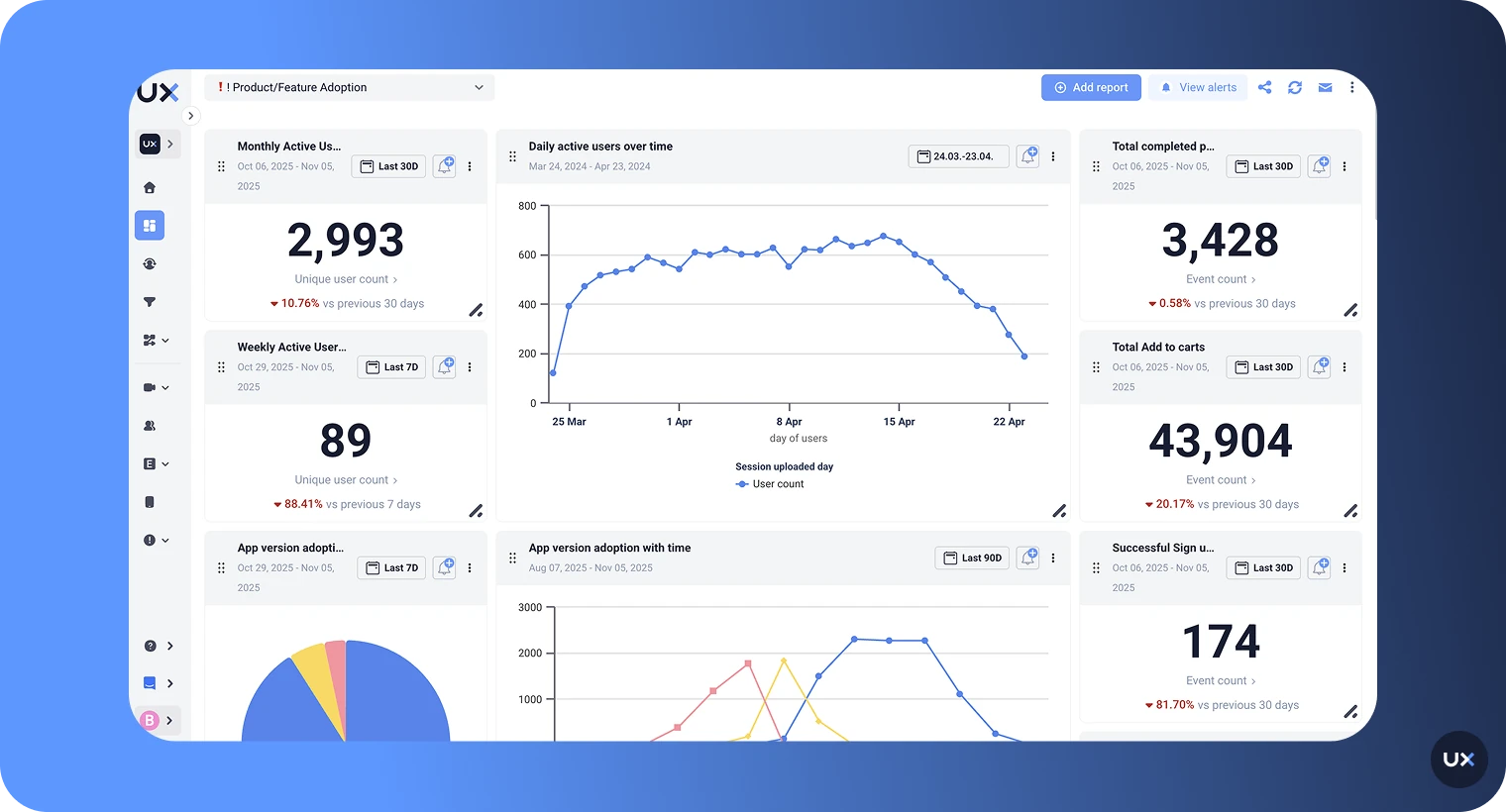
UXCam is an AI-powered product analytics platform built to help product teams understand what users do and why. It provides cross-platform analytics for both web and mobile, making it a strong fit whether you're focused on app behavior, web experience, or both.
The platform connects real user context with quantitative metrics in one place. Teams get session replays, heatmaps, funnel analytics, retention dashboards, crash analytics, and AI-powered insights without needing a separate data team to pull it all together.
Product, growth, engineering, and support teams use UXCam for:
Reviewing auto-captured user sessions across mobile and web
Discovering how users interact with specific screens and flows
Understanding the reasons behind low conversion and retention rates
Capturing where users drop off and identifying early signs of frustration
Tracking UI freezes, crashes, and rage taps
Prioritizing issues based on real user impact
All of these are made possible with UXCam’s built-in tools:
and many more...
Why is UXCam the best alternative to FullStory?
Compared to FullStory, UXCam is the more practical choice for product teams that want clear answers fast without the complexity. FullStory is positioned as a broader Digital Experience Intelligence platform with strong web roots. UXCam is purpose-built for product and UX teams who need to connect real user behavior with actionable next steps across mobile and web.
UXCam makes it easy to see what's happening inside your product through session replays, heatmaps, user journeys, and behavioral analytics. Instead of guessing why users drop off or get stuck, you can watch it happen. It also works across modern app frameworks like iOS, Android, React Native, Flutter, and Xamarin and tracks web experience in the same platform.
Where UXCam really stands out is in how quickly it helps you find issues that matter. You can spot friction like crashes, freezes, confusing screens, or frustrated taps, then follow the full user path to see what triggered the problem.
On G2, UXCam scores higher than FullStory across key categories: ease of setup (8.9 vs. 8.3), quality of support (9.3 vs. 8.9), and ease of use (8.6 vs. 8.1). For teams that want to move fast without a steep learning curve, that matters.
Where UXCam goes further: Tara, UXCam's AI product analyst
This is the biggest difference between the two platforms and where AI-powered product analytics becomes more than a buzzword.
FullStory offers StoryAI, which surfaces behavioral patterns from session data. It's useful for spotting trends. But it stops at observation. It doesn't interpret what those patterns mean for your product, and it doesn't tell you what to do next.
UXCam takes a fundamentally different approach with Tara, its AI product analyst.
Tara doesn't just summarize sessions or flag anomalies. She watches real session recordings using visual intelligence; not metadata, event logs, or predefined tracking. This means she can detect friction that traditional tools miss entirely: confusing UI states, non-responsive elements, hesitation, hidden buttons, and broken flows that never get tagged as "errors."
She then explains why users are struggling and provides concrete action plans backed by direct links to the session evidence. Teams can validate her findings instantly and move straight to fixing the problem.
Think of it this way: FullStory's AI tells you what happened. Tara tells you why it happened and what to do about it.
For product teams looking for an AI product analytics tool that goes beyond dashboards and pattern detection, this is a meaningful upgrade.
And unlike tools that require extensive event setup before their AI features work, Tara operates with zero-event dependency. Teams typically track only 1–5% of their app through manual events. Tara provides visibility into the untagged 95%; so you can find the problems you didn't know to look for.
I asked two core questions and got good answers to them. I have things that I did not know that are a problem to me, so it's revealing.

- Kareem Al Masri Head of Product @ LikeCard
Amplitude vs FullStory
G2 rating: 4.5/5
Cost: Free for up to 10 million monthly events and core analytics features.


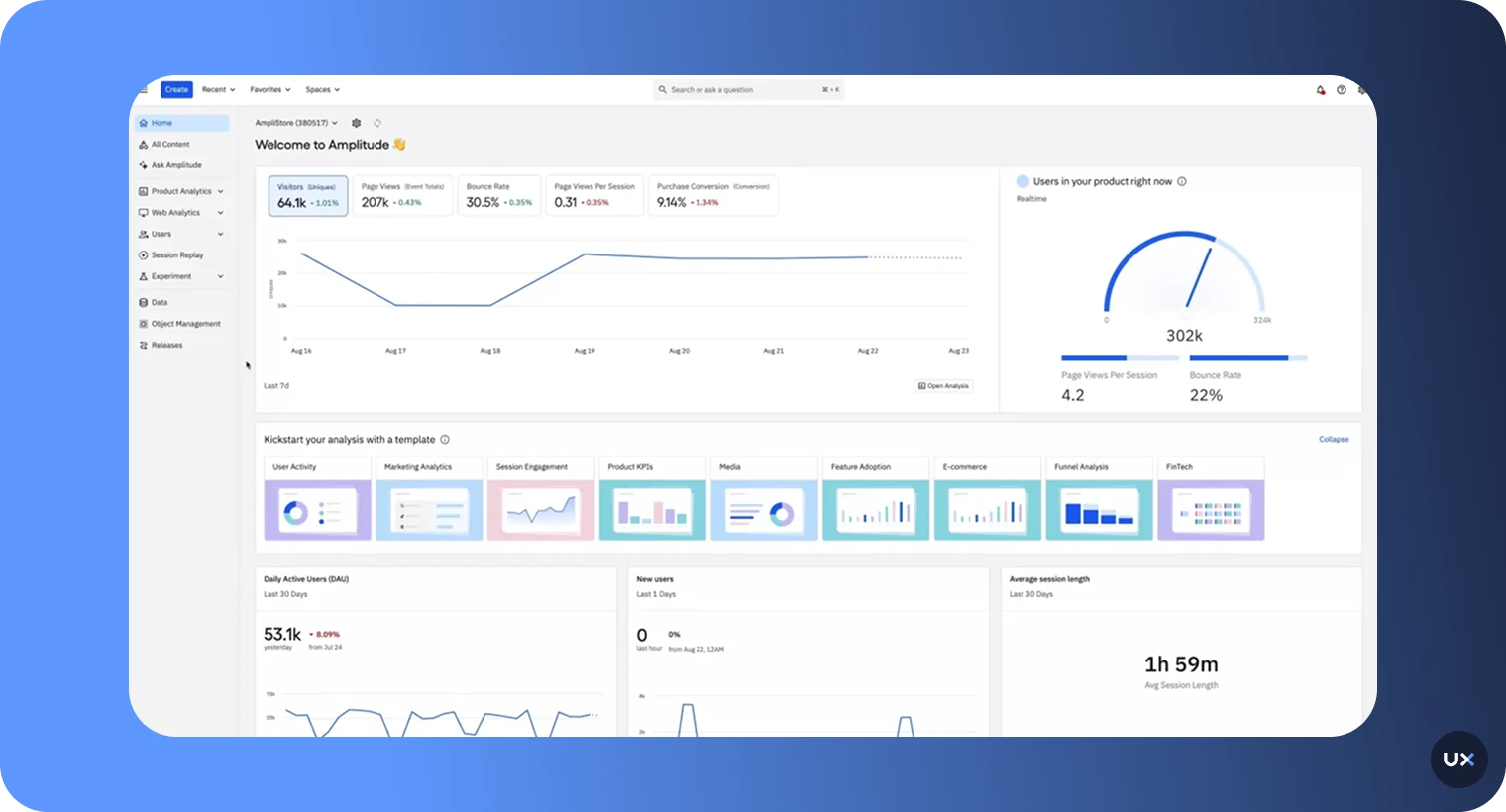
Amplitude offers three separate products serving different goals: Amplitude Analytics, Amplitude Experiment, and Amplitude Recommend. We’ll focus on Amplitude Analytics as the FullStory alternative.
What does Amplitude have to offer?
Core analytics features
Behavioral reports
Digital journey mapping
Real-time performance tracking
Conversion drivers identification (AI-powered feature)
Collaboration tools
Predictive analytics (AI-powered feature)
What makes Amplitude a good alternative to FullStory?
Alongside collecting behavioral data that helps product teams understand how users navigate their apps, Amplitude Analytics uses the power of machine learning to forecast behavior patterns. FullStory won’t do it for you.
Amplitude Recommend is an audience segmentation tool that helps you personalize user experiences. By clustering users into cohorts, you can apply predictions and recommendations for a particular group. While machine learning is cool, you’ll have to see if having a sophisticated robot helper is worth it.
Chartbeat vs FullStory
G2 rating: 4.4/5
Cost: Chartbeat doesn’t offer a free version. For pricing information, reach out to the Chartbeat team.


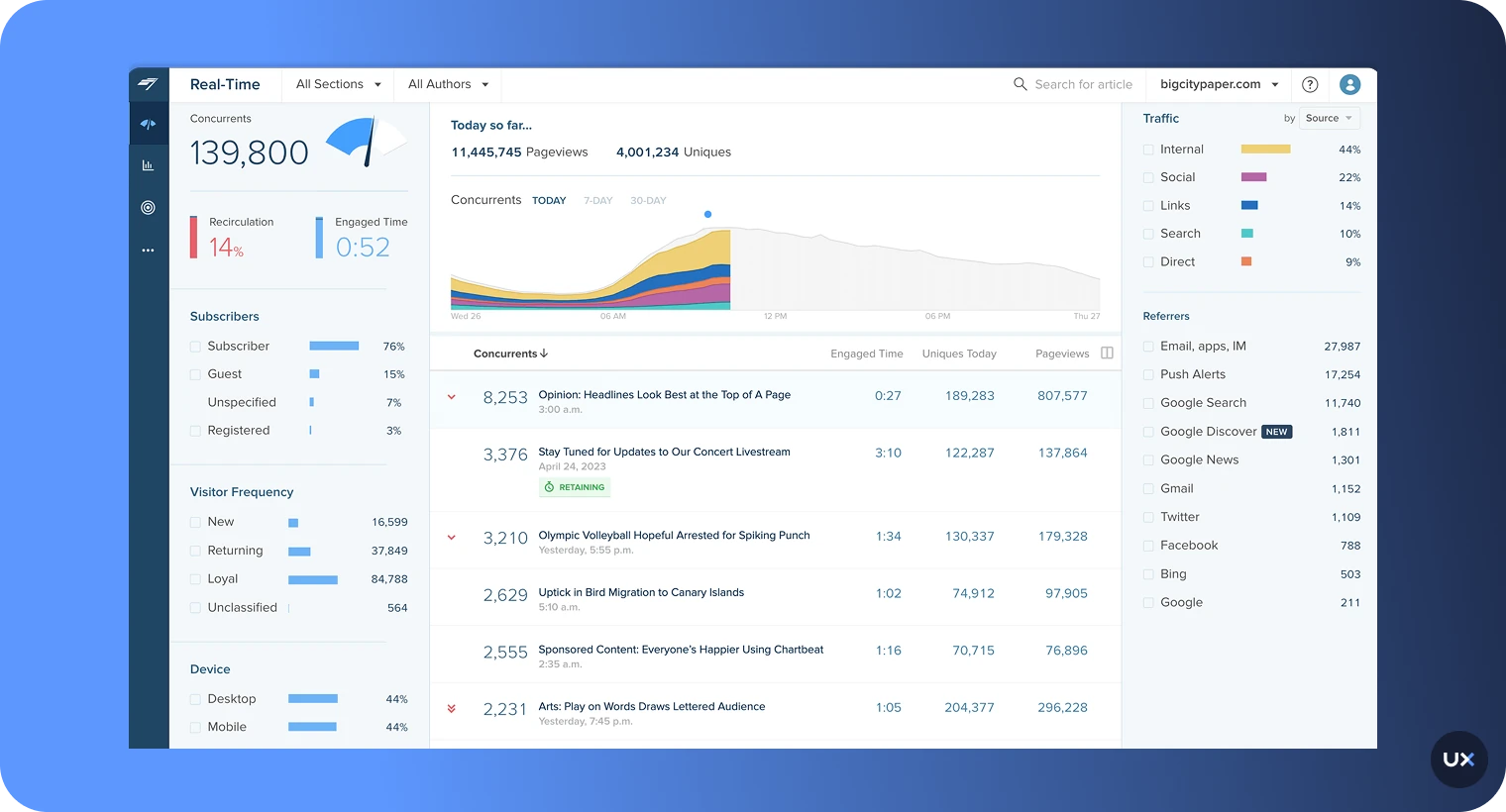
Media companies like Refinery 29 and Rolling Stone choose Chartbeat over FullStory for its dedicated content analytics toolkit designed for the news industry and content-driven sites. The platform identifies the best-performing content pieces and displays audience insights, like demographics, device types, and interests. Unlike FullStory, Chartbeat offers headline testing and content optimization tools.
Rather than focusing on the ‘user’, Chartbeat zeros in on ‘the reader’. You can use Chartbeat to filter data based on authors, sections, referrers, traffic sources, and so on. You can also use Chartbeat for apps to better understand how readers are engaging with your content.
Why is Chartbeat a good alternative to FullStory?
The company calls its product ‘Twitter search’ for performance reporting, referring to its capability to deliver instant insights into everything happening on your site. Contrary to FullStory, Chartbeat focuses primarily on content insights rather than pure product analytics.
If you’re looking for a performance analytics tool, you’d better pay attention to the other tools on this list. But if you’re a publisher, this product is right for you.
Mouseflow vs FullStory
G2 rating: 4.6/5
Cost: Free for up to 500 recordings per month. Pain plans start at $39/month.


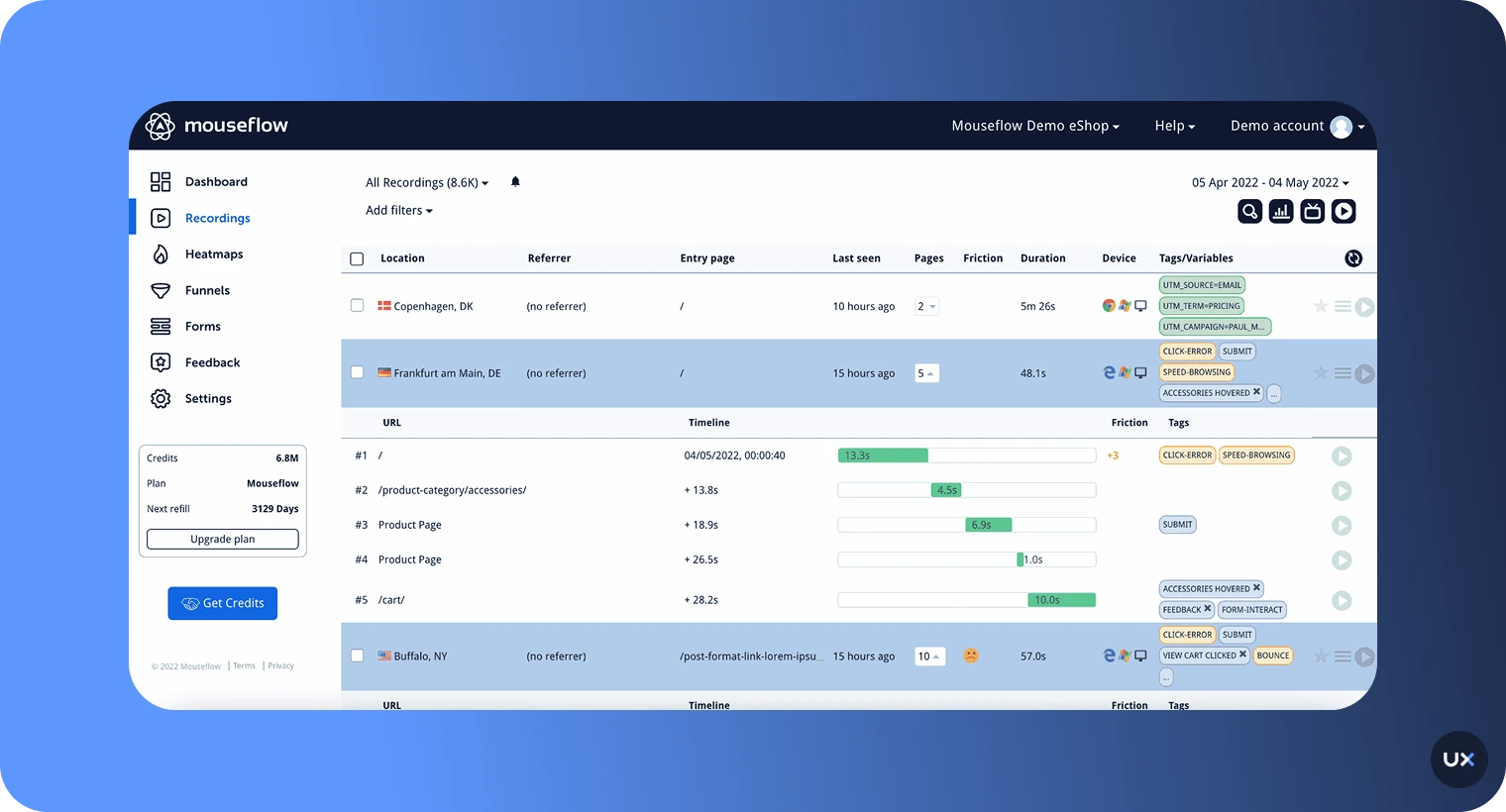
Built for websites, Mouseflow is a behavior analytics platform that focuses on improving conversions. Like FullStory, they offer heatmaps and session replays. The web analytics toolkit includes:
Heatmaps
Session replays
Funnel analytics
Field-by-field form analytics
Feedback tool
Why is Mouseflow a good alternative to FullStory?
While FullStory is a favorite among enterprises with big budgets, Mouseflow is a favorite among early-stage startups and small businesses looking for an affordable, basic tool. Unlike the other tools on this list, Mouseflow is heavily focused on website CRO.
One of the biggest differences between Mouseflow and FullStory is simplicity. Mouseflow is primarily used by customers for their recording and heatmap tools, and not a full user behavior solution with both quantitative and qualitative insights. FullStory has a more robust feature set for a deeper look into the user behavior.
The main disadvantage of Mouseflow, if you’re looking for a FullStory alternative, is that they aren’t for iPhone or Android mobile apps. It’s an ideal tool if you want to increase conversions on your blog or online store.
You might also be interested in: Mobile app metrics: essential metrics to track in your job role
Datadog vs FullStory
G2 rating: 4.3/5
Cost: Datadog lets users purchase specific features based on their needs – the resulting product price depends on the features selected.


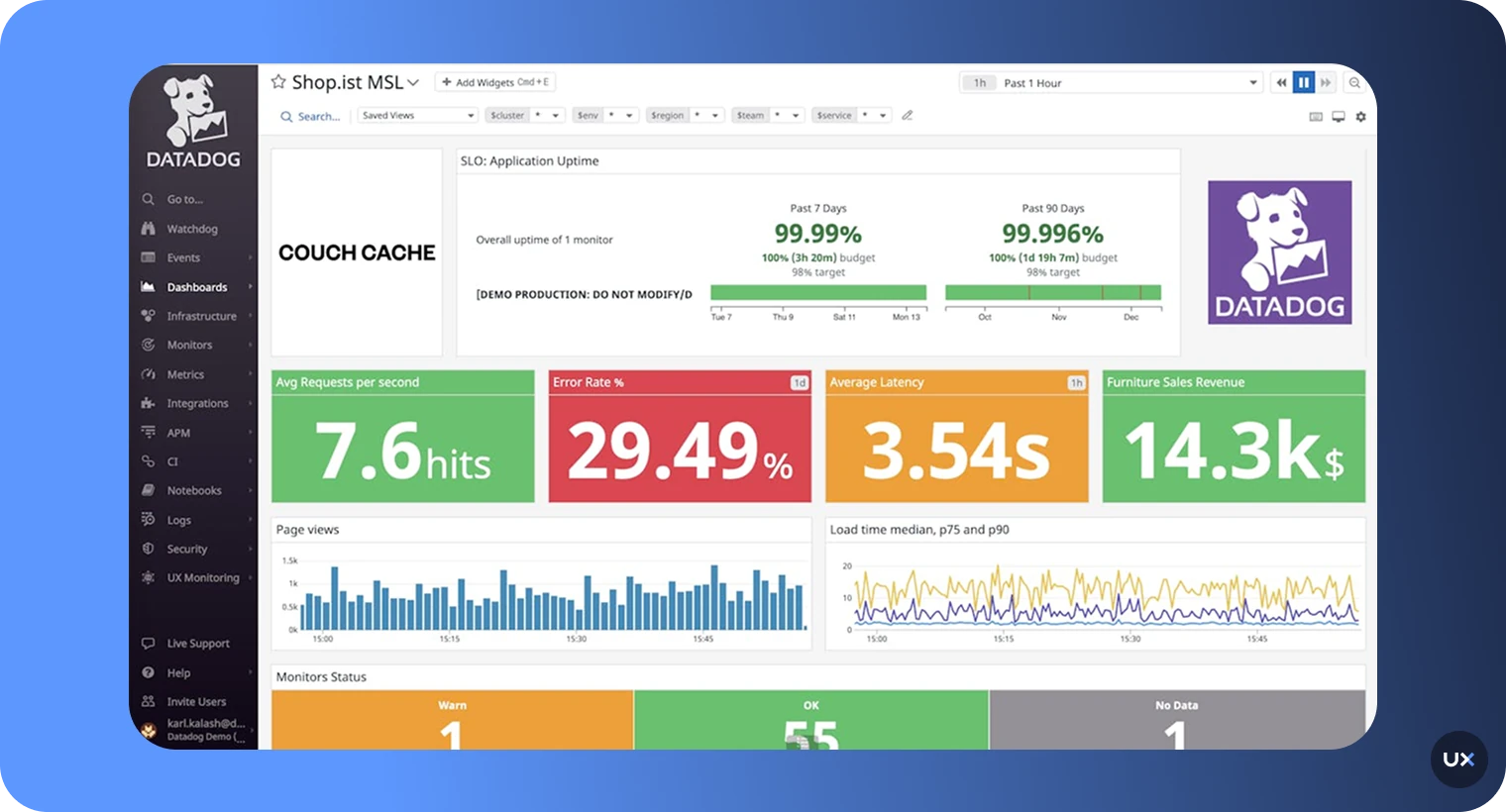
Datadog’s Real User Monitoring (RUM) is analytics software that helps product teams uncover UI issues promptly, optimize frontend performance, and get insights into end-user behavior. Datadog is primarily designed for engineers, whereas FullStory is meant to be used by the whole product team. To use Datadog, you’ll have to be fluent in its query syntax. It’s not the most user-friendly tool, and the dashboards aren’t meant for non-technical stakeholders.
With Datadog’s RUM, product teams can:
Monitor user journeys
Collect real-time product insights
Keep track of the application’s frontend performance
Identify the root cause for poor user experience
Automatically segment application errors
Analyze product usage by a range of dimensions
Simulate user journeys and correlate results with real-time digital experiences
Why is Datadog a good alternative to FullStory?
If you’re looking into FullStory for performance monitoring, detecting problems with deployments, and measuring the overall performance of your app, consider using Datadog instead. It's a monitoring and analytics tool specially made for IT and DevOps teams.
Unlike FullStory, Datadog has a transparent pricing plan based on what you need e.g., infrastructure, CI visibility, real user monitoring, and much more. Their plans are carefully laid out by use type e.g., mobile, browser, browser premium, which makes it easier to estimate a quote. FullStory, on the other hand, has a very opaque pricing page, and you have to contact them to get a quote based on your needs.
Plerdy vs FullStory
G2 rating: 4.7/5
Cost: Plerdy offers a range of pricing across All-in-One, UX&CRO, Pop-Up, SEO, and Ecommerce packages, with monthly or yearly payment options, starting from free to $39 per month for add-ons.


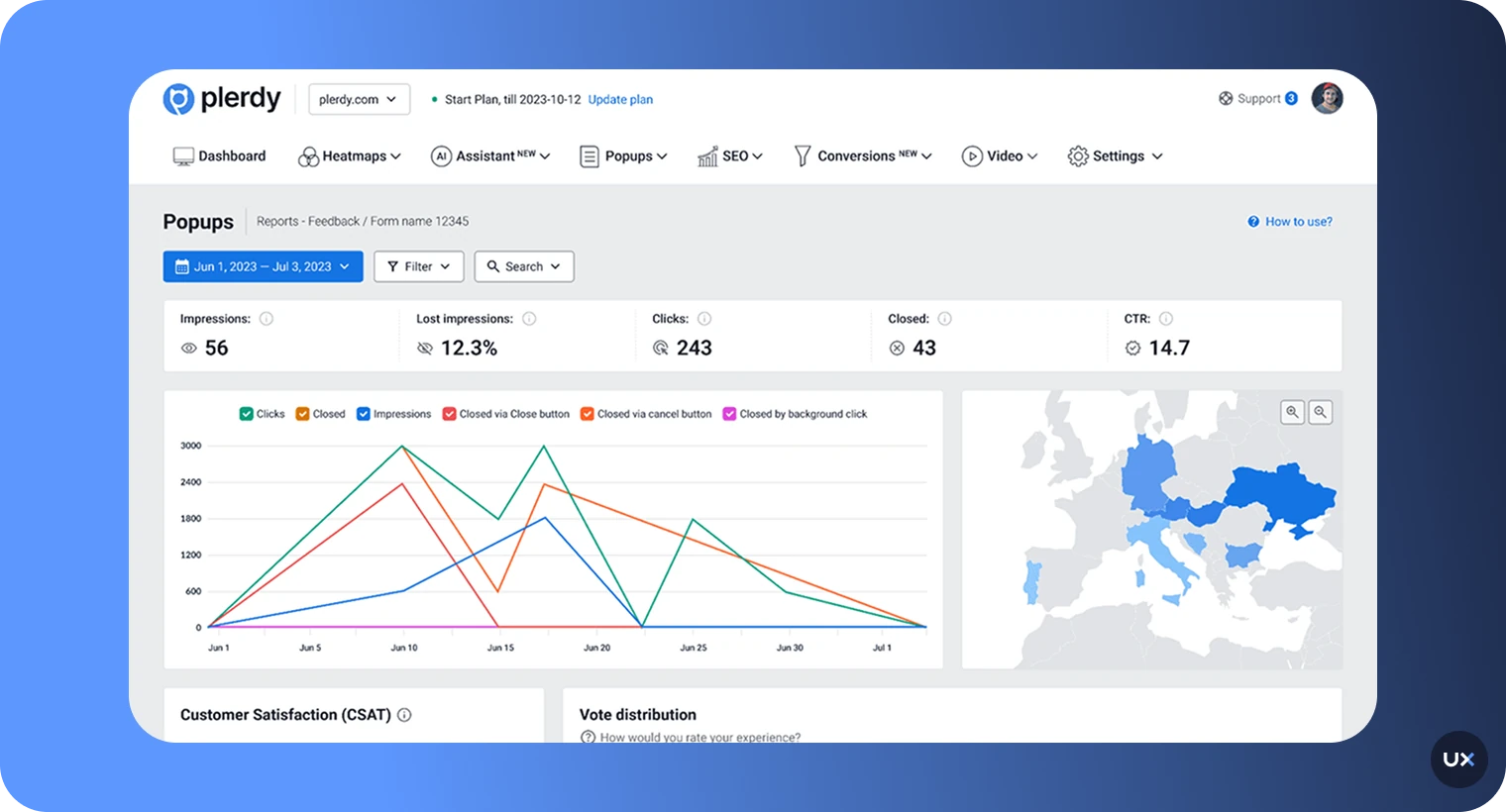
Plerdy is a robust Conversion Rate Optimization platform offering a blend of UX and SEO tools designed to track, analyze, and convert website visitors into buyers. This all-in-one platform empowers businesses to optimize their website performance, understand user behaviors, enhance sales, and collect valuable feedback.
Key features of Plerdy include:
Website Heatmap
Session Replay
NPS Software
eCommerce Analytics
Event Tracking Tool
Conversion Funnel Analysis
SEO Checker
Why is Plerdy a good alternative to FullStory?
Plerdy is a compelling alternative to FullStory for several reasons. Firstly, Plerdy offers a robust set of website analytics and conversion optimization tools at a more affordable price point. Its straightforward UI and features make it accessible to all ability levels.
Plerdy's heatmaps, session recordings, and click maps provide detailed insights into user behavior, helping businesses identify and rectify conversion bottlenecks effectively.
Additionally, Plerdy offers a comprehensive suite of SEO tools, including a SERP tracker and competitor analysis, empowering businesses to enhance their online visibility. With its cost-effectiveness, user-friendly design, and powerful analytics capabilities, Plerdy stands out as a solid alternative to FullStory.
Heap vs. FullStory
G2 Rating: 4.4/5
Cost: Free plan (up to 10,000 sessions/month) and custom paid tiers.


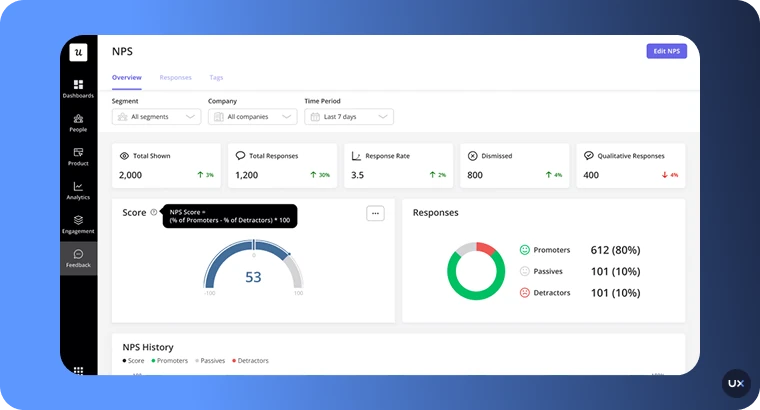
Heap automatically captures all user interactions without manual event tagging, unlike FullStory, which focuses on high-fidelity session replay and deep behavioral insights. Heap’s event-based analytics allow teams to dive into user journeys with minimal setup, making it ideal for those seeking quick insights and detailed funnel analysis.
While FullStory excels in real-time session replay and AI-driven behavioral insights, Heap’s analytics depth is geared more towards quantitative data with powerful funnels and cohort tracking, which can be faster for teams focusing on conversion rates and user path analysis.
Why is Heap a good alternative to FullStory?
Compared to FullStory, Heap offers automatic event capture, allowing teams to start analyzing behavior without manual tagging or setup, making it a faster, more efficient solution for teams that want immediate insights.
While FullStory provides detailed session replays, Heap’s focus on quantitative analytics and funnel analysis allows teams to understand user behavior patterns more easily. However, FullStory’s session replays and deep user context are a significant strength when teams need qualitative insights into user struggles.
Heap’s free tier and flexible pricing are especially attractive for small teams or startups, whereas FullStory’s pricing structure is more tailored for larger enterprises.
Glassbox vs. FullStory
G2 Rating: 4.9/5
Cost: Custom pricing.


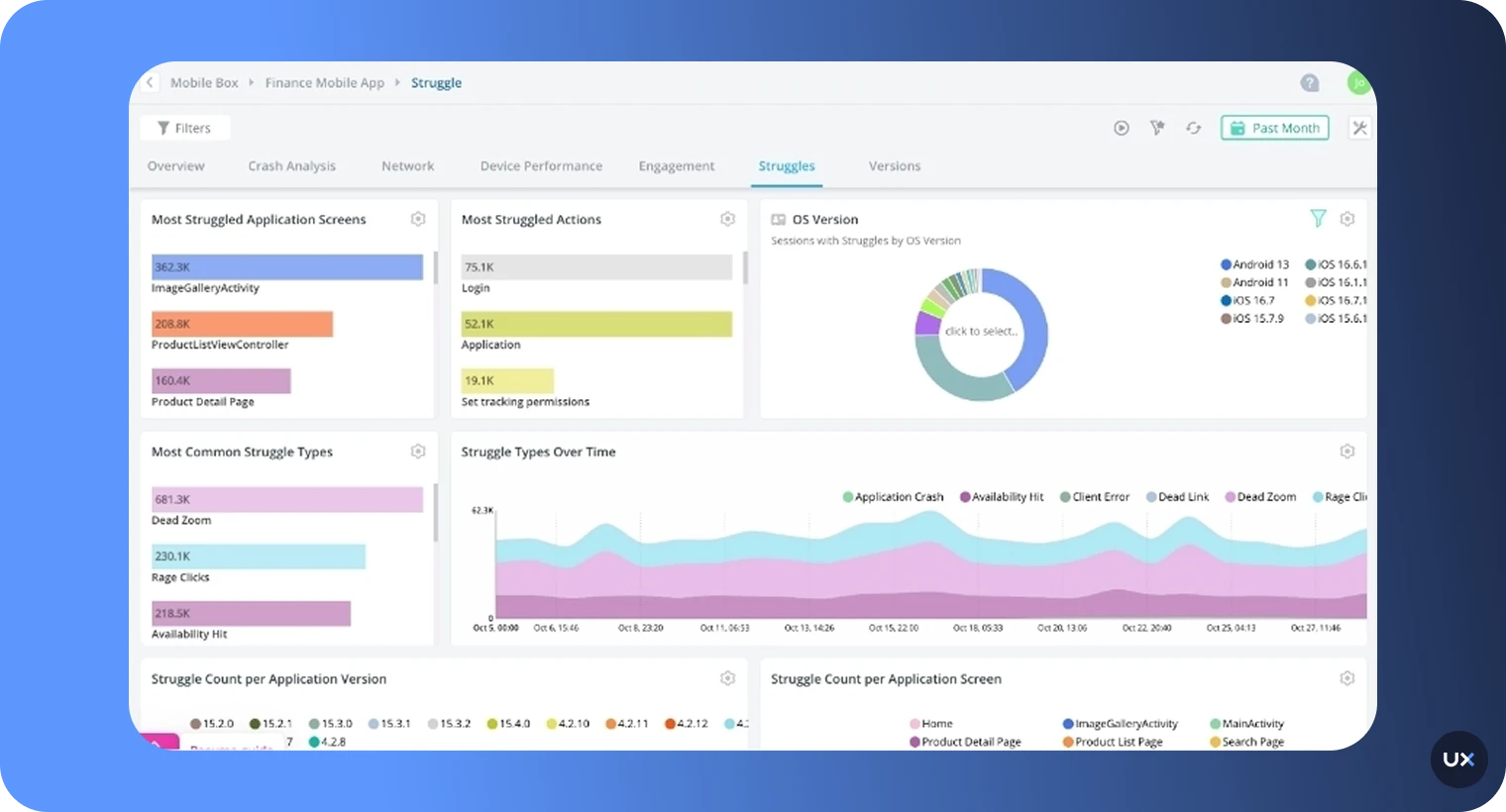
Glassbox offers comprehensive session capture and advanced funnel analysis across both web and mobile, similar to FullStory. However, compared to FullStory, Glassbox is often seen as easier to set up and administer, with a stronger focus on AI-assisted struggle scoring that helps teams pinpoint user issues more quickly.
FullStory is known for its in-depth session replays, which offer granular insights into user behavior, but Glassbox’s automated session capture and real-time behavior insights provide a more streamlined approach for teams needing immediate answers at scale.
Why is Glassbox a good alternative to FullStory?
Compared to FullStory, Glassbox excels at providing 100% automatic session capture, which ensures that teams never miss a critical user interaction. This automatic setup saves time and reduces manual tagging efforts, which FullStory requires.
Glassbox’s AI-powered struggle scoring helps teams prioritize friction points and optimize user journeys faster, an area where FullStory's reliance on manual session inspection might be slower.
Ease of use is another area where Glassbox stands out, often preferred for its intuitive interface, which allows non-technical teams to act on insights without steep learning curves.
Finally, Glassbox’s granular session replay filtering provides more specific insights, especially in enterprise environments where identifying issues across large user segments is crucial.
Mixpanel vs. FullStory
G2 Rating: 4.5/5
Cost: Free tier and tiered paid plans (Growth, Enterprise).


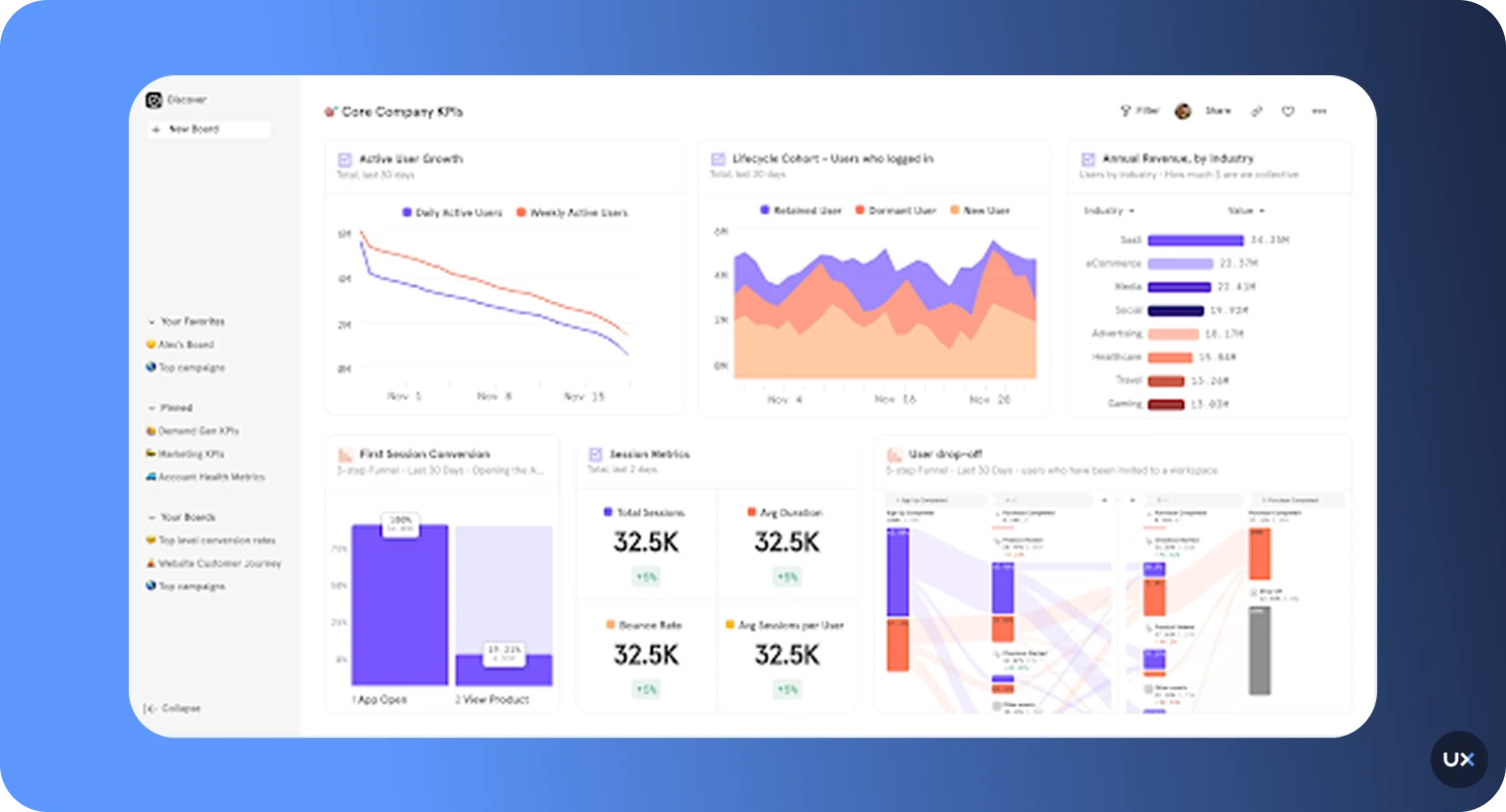
Mixpanel is a behavioral product analytics platform that uses an event-based model to track user actions across web and mobile. Compared to FullStory, which is known for its detailed session replays, Mixpanel focuses on deep quantitative insights, such as funnels, retention, and cohort analysis.
FullStory excels at providing real-time behavioral context through session replay and AI-driven insights; Mixpanel, however, is more metrics-driven and better suited for teams looking to focus on user paths, conversions, and long-term trends. It’s especially popular among product teams that need predictive insights to forecast future behaviors and guide decision-making.
Why is Mixpanel a good alternative to FullStory?
Mixpanel’s event-based tracking allows teams to dig deeper into user actions and create custom funnels that highlight where users drop off or engage. This is something FullStory doesn’t focus on as much, as its strength lies in session replay and qualitative insights.
Mixpanel also stands out for its collaborative dashboards and unlimited user seats, which make it easier for teams to align on insights without added costs per user—something FullStory lacks.
Lastly, Mixpanel’s native integration with data warehouses allows teams to access truly unified analytics, which is ideal for large datasets and scaling, something FullStory’s limited tagging system doesn’t support as effectively.
Hotjar vs. FullStory
G2 Rating: 4.6/5
Cost: Free plan, and paid plans starting from $49/month.


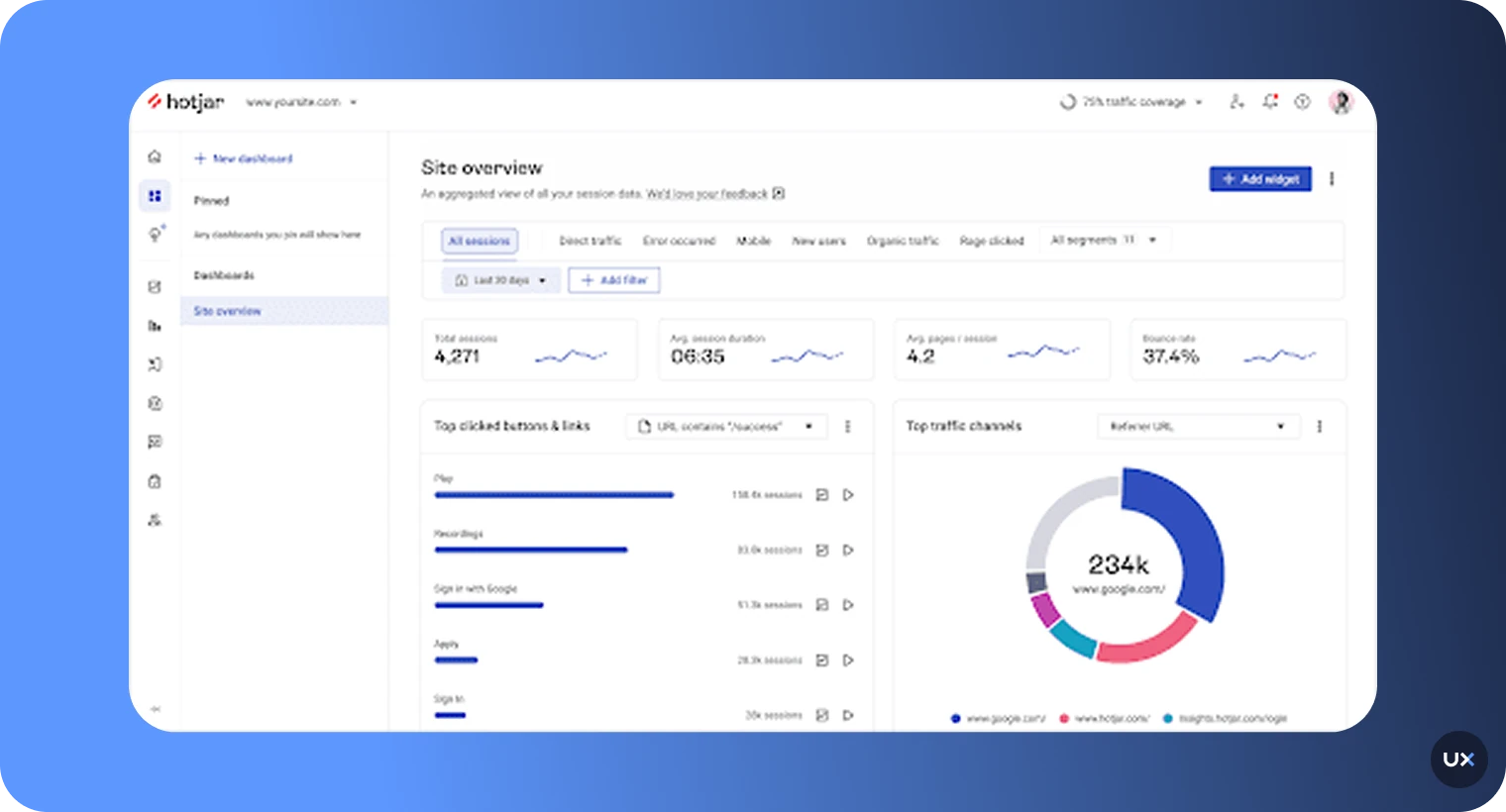
Hotjar is a behavior analytics platform that focuses on visualizing user behavior on websites using heatmaps, session recordings, and user feedback tools. Compared to FullStory’s deep session indexing and cross-platform analytics, Hotjar emphasizes qualitative insights, such as user sentiment surveys and feedback widgets, which help teams understand why users behave a certain way.
FullStory, on the other hand, offers detailed session replays with rich, quantitative data, providing deeper insights into the specifics of user behavior and cross-platform interaction.
For teams looking for a fast, easy setup focused on website UX and conversion optimization, Hotjar offers quick insights with minimal complexity, whereas FullStory is more sophisticated, suited for teams requiring robust, granular analytics across both web and mobile.
Why is Hotjar a good alternative to FullStory?
Compared to FullStory, Hotjar’s strength lies in its focus on qualitative feedback, using surveys and direct user insights to complement behavior data. This makes it a strong choice for marketing and UX teams looking to understand the motivations behind user actions, rather than just tracking the actions themselves.
While FullStory excels at providing detailed session replays and complex analytics, Hotjar is easier to set up and use, especially for small teams or those with limited technical expertise. Its freemium tier and quick onboarding make it ideal for teams that need actionable insights fast without the overhead of advanced training or setup.
FullStory’s advanced AI-driven insights and cross-platform support provide more detailed user behavior analysis, but Hotjar shines in situations where simplicity and user sentiment feedback are key priorities.
Choosing a FullStory alternative
As you've read from our list, there are options out there if you've got a tighter budget or want a company that specializes in one of FullStory's special features.
Ready to try the best FullStory alternative today? Get 3,000 free monthly sessions and access all features with UXCam’s free trial.
You might also find these interesting;
FullStory React Native Setup, Review and Best Alternative
FullStory Session Replay - Feature Review & Best Alternative
FullStory for Mobile Apps Reviewed - Features, Pros & Cons
Contentsquare vs FullStory: Features, Pricing & Best Alternative
FullStory vs Amplitude - Key Features & Best Alternative
LogRocket vs FullStory - Which Mobile UX Tool Is Best for You?
AUTHOR
Adelina Karpenkova
Adelina is a content marketer and a freelance writer with a passion for working with mission-driven organizations. For years, she’s been helping SaaS companies strengthen their online presence with the help of quality content.


Related articles


Product Management
13 Best Product Management Tools 2026 & When to Use Them
Find out the top tools that the best product managers use daily to perform better at...


Jane Leung
Product Analytics Expert


Curated List
As 14 Melhores Ferramentas de Análise Web em 2026
Descubra as melhores ferramentas de análise web. Quer melhorar a experiência do usuário no seu site? Saiba quais são os recursos indispensáveis para uma análise web...


Jonas Kurzweg
Product Analytics Expert


Curated List
12 Best Customer Analytics Tools and Platforms 2026
In this article, we've compiled a list of customer analytics tools trusted by thousands of businesses worldwide and insights to help you select one that best suits your...


Tope Longe
Product Analytics Expert
What’s UXCam?